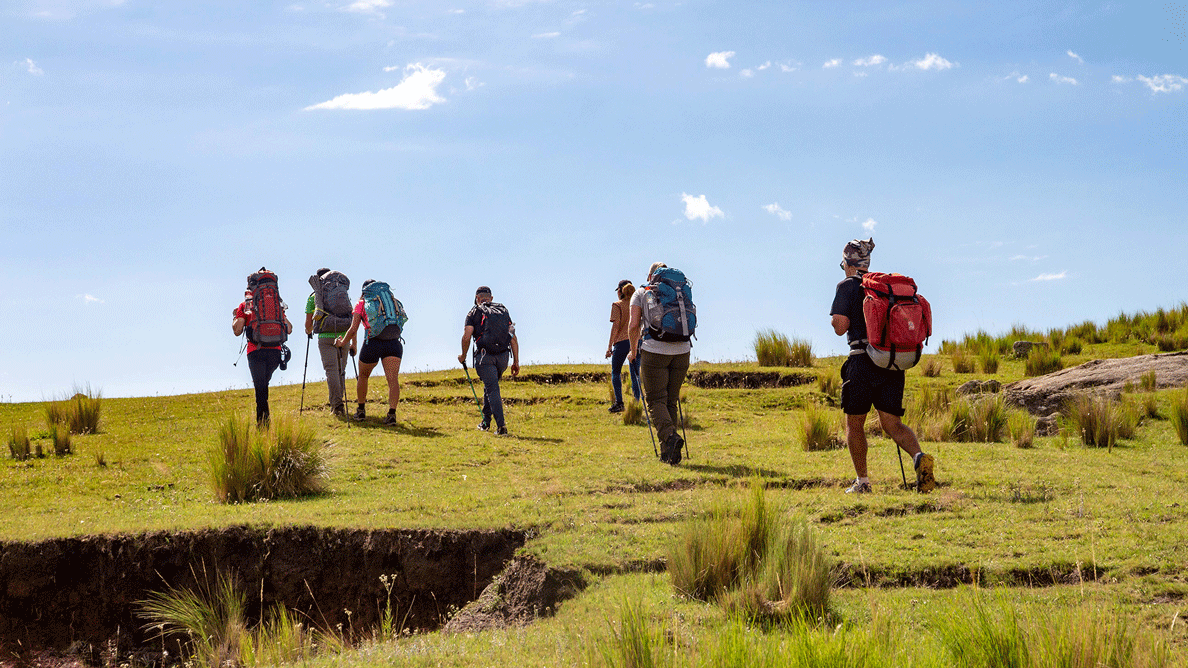
At 2,790 meters (9,153 ft) above sea level, Mount Champaquí is the highest point in the province of Córdoba and the most iconic trekking destination in central Argentina. Every year, hundreds of people choose to leave the city behind, turn off their screens, and venture into the Sierras Grandes to disconnect from the routine.
However, the mountain demands respect and preparation. If you are planning to explore this natural paradise and have questions about the required fitness level, gear, or safety, you’ve come to the right place. In this definitive guide, we answer the most frequently asked questions so you can experience Champaquí with absolute peace of mind.
How long does it take to climb Mount Champaquí?
The ascent time depends on the chosen route and the group's pace, but the safest and most enjoyable standard for a classic trek from Villa Alpina is 3 days and 2 nights.
- Day 1: The Approach. An uphill hike from Villa Alpina toward the base of the mountain, where the mountain huts (refugios) are located. It is a day of moderate effort to acclimate the body.
- Day 2: Summit Day. We leave the hut early, carrying only the essentials (without the main weight of the backpack), to ascend to the highest point (2,790 m), enjoy the view, and return to the hut for the night.
- Day 3: The Descent. We begin the trek back down, using the same trail as the first day.
Attempting it in less time (such as a single-day round trip) requires a higher level of fitness. It can be done in two days with one night at the huts, or in one grueling day starting very early in the morning and returning by nightfall.
Is climbing Champaquí dangerous? (The truth about safety)
The mountain is not dangerous if visited with the proper respect, gear, and company. However, Champaquí features a high-mountain climate: a sunny day can quickly turn into a closed storm with thick fog that eliminates all visibility.
The main risks are becoming disoriented due to low visibility and underestimating physical fatigue. While the trails are well-marked, the problem is their sheer number—it is not easy to know which one is correct. The area is home to many livestock and ranches (estancias), and different paths connect these locations; following the wrong one can lead you far from your destination. Knowing the route or key landmarks is vital.
How to guarantee safety? The golden rule is to always go with certified professional guides. A guide doesn't just know the way by heart; they carry VHF communication, a first-aid kit, WFR (Wilderness First Responder) training, and, most importantly, the ability to make critical decisions if the weather turns. Technology may fail, but local knowledge does not.
What is the best time of year to go?
Champaquí can be climbed year-round, but each season offers a radically different landscape:
- Autumn (March to June): The ideal time. The weather is more stable, temperatures are pleasant for hiking, there is less rain, and visibility is usually excellent.
- Spring (September to November): A great time with moderate temperatures and blooming nature, though rain becomes more frequent.
- Summer (December to February): Days are long and very warm. This is the season for frequent rain and thunderstorms in the mountains; one must stay alert to the forecast.
- Winter (July and August): For those seeking a challenge with sub-zero temperatures. Days are often pleasant, but snow or ice may be found on the trail.
What do I need to pack?
To hike the mountain comfortably, the key is to pack smart. Less unnecessary weight means more enjoyment. The fundamental rule is to apply the 3-Layer Theory for your clothing:
- Base Layer (Thermal/Moisture-wicking): To keep sweat away from the skin and stay dry.
- Mid Layer (Insulation): A fleece or synthetic jacket to retain body heat.
- Outer Layer (Waterproof/Windbreaker): Your shield against rain and strong gusts.
Essential items include:
- Trekking footwear (boots or trail shoes with excellent grip, broken-in beforehand to avoid blisters).
- Mountain backpack (approx. 40 to 60 liters).
- Sleeping bag suitable for mountain hut temperatures.
- Water containers for at least 2 liters.
- Sunscreen, sunglasses, and a hat.
- Trekking poles are highly recommended.
(Note: At Mons, we send you a detailed gear and clothing list prior to every trip).
How much does a guided climb cost?
The cost of an expedition varies based on the services included. A premium trip that guarantees full board, mountain huts, professional guides, and insurance is an investment in your peace of mind.
Currently, the price for our 3-day Champaquí expedition is $390,000 ARS (promotional cash price). Key detail: To guarantee the highest logistical quality, spots are secured with a deposit. Please note that due to hut and transport policies, reservations are non-refundable if canceled within 21 days of departure (though we always review cases of force majeure).
The MONS Experience: Why choose us?
Our focus is not on athletic performance, but on providing a total urban disconnect with high-end service in a wild environment.
- Small Groups: We hike at a pace that allows you to enjoy, breathe, and talk, ensuring a personal and warm experience.
- Inclusive Meals: We handle all the catering. We provide full board and prepare special menus for vegetarian, vegan, or gluten-free diets right in the heart of the mountains.
- Strategic Lodging: We sleep in mountain huts. While services are limited compared to the city, it is the perfect setting to rest and share stories at the end of the day.
- Total Management: You just pack your bag; we take care of the logistics and safety.
Daily Hiking Distance and Fitness Requirements for the Ascent
One of the biggest hurdles when leaving the city is the fear of not being physically fit enough or slowing down the group. The good news is that you don't need to be an elite athlete to join us. Our approach is designed for people looking to disconnect from their routine, not for breaking sporting records.
However, we must be realistic: the mountain demands effort. The true challenge lies not in speed, but in endurance against fatigue and the mental willingness to step out of your comfort zone. It’s important to note that this experience shouldn't be compared to a casual walk in an urban park.
What is the daily physical effort on the classic 3-day route from Villa Alpina?
- Day 1 (The Approach): This is the day of the greatest sustained effort. You will cover between 14 and 15 kilometers (approx. 9 miles) in a constant ascent toward the mountain huts while carrying your backpack. It is a long day, but since we hike in small groups, the pace is steady and relaxed. We make strategic stops to hydrate, eat, and enjoy the landscape. Typically, the trek takes between 6 to 8 hours, with an elevation gain of approximately 800 meters (2,625 ft).
- Day 2 (Summit Day): The great advantage of this day is that we leave our heavy gear at the hut and head out with much lighter packs. We cover between 10 and 12 kilometers (6-7 miles) round trip, navigating an elevation gain of 690 meters (2,263 ft) over rockier terrain to finally reach the summit at 2,790 m.s.n.m.
- Day 3 (The Descent): It’s time to retrace the path from the first day. While it is less demanding cardiovascularly, it requires significant leg and knee strength to stabilize your body weight on the downhill sections.
So, do I need to train a lot?
If you lead a moderately active life (you play recreational sports, hit the gym a couple of times a week, cycle, or regularly walk long distances), you are in perfect condition to join. The most valuable things you can bring to the mountain are mental resilience, a spirit of camaraderie, and the desire for a transformative experience. We take care of regulating the intensity so that the group moves safely and enjoys every step.